How InDecision Conviction Scores Work — And Why 70 Is the Line
Conviction scores are the output of the InDecision Framework — a 0-100 number that translates six factors into a single decision input. Here's exactly how to read and act on them.
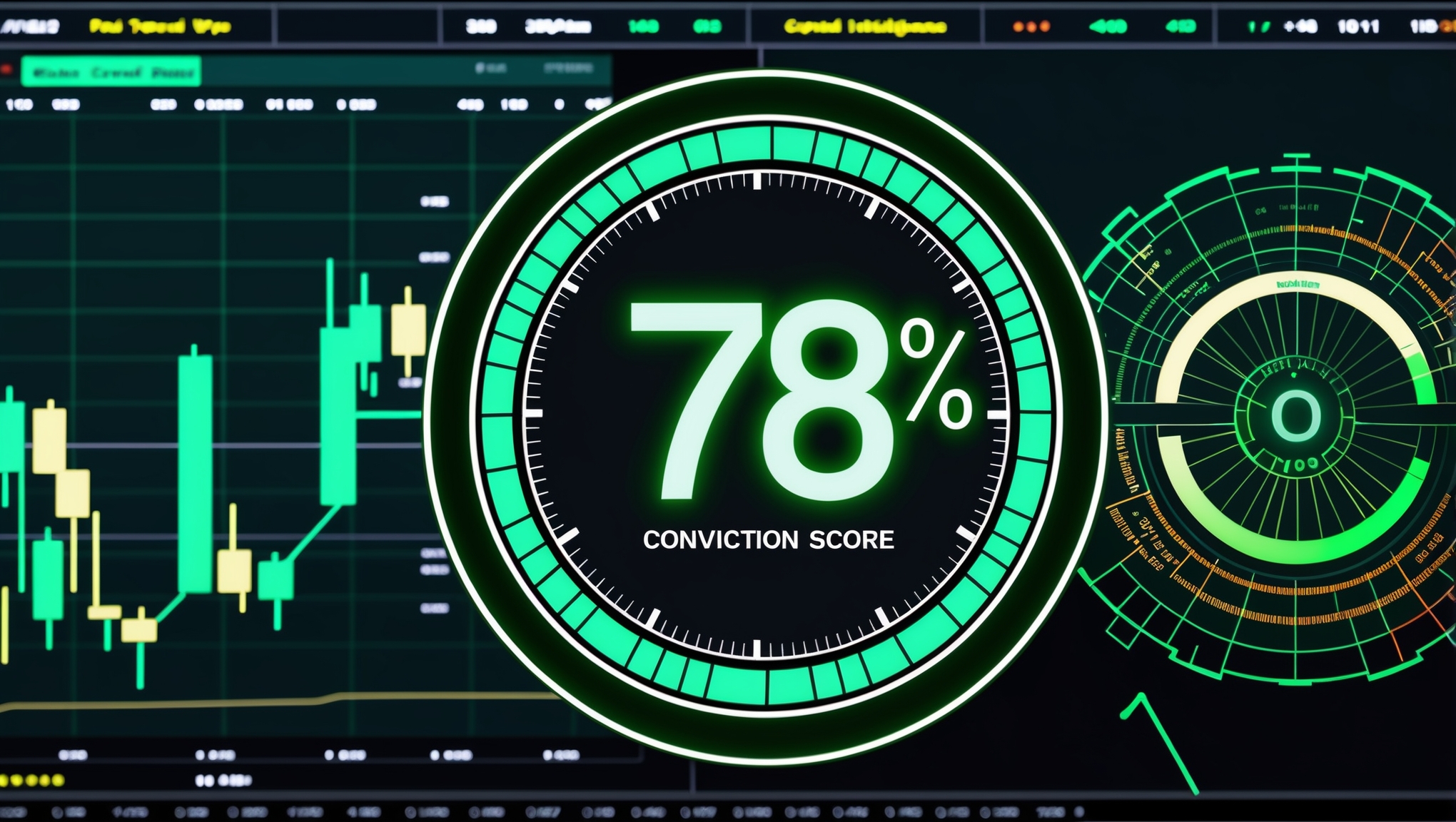
The InDecision Framework doesn't just output "long" or "short." It outputs a conviction score.
That number — 0 to 100 — is the most important thing the framework produces. It determines not just direction, but confidence level, position sizing, and trade management protocol.
The Score Is Not a Prediction
Let me be precise about what the conviction score is.
It's not the probability that the trade wins. It's not a measure of how far price will move. It's a composite measure of factor alignment — how many of the six factors agree with each other and with the declared bias direction.
High conviction means the factors are aligned. Low conviction means they're mixed. ABSTAIN means they're contradictory or inconclusive.
The Three Zones
70-100: Action Zone
At 70% and above, all or nearly all factors are aligned. This is where InDecision trades. Position sizing is full (within risk management parameters). Trade management is by structure — you hold until structure breaks, not until you feel uncomfortable.
The 70% threshold isn't arbitrary. Backtesting across 7 years of data showed that sub-70 conviction trades had significantly lower expectancy and higher drawdown, even when they won directionally. The extra 20 points of conviction matter.
40-69: Reduced Size Zone
Mixed signals. Some factors agree, some don't. InDecision recognizes the potential setup but reduces sizing to 40-50% of normal. These trades exist because sometimes the setup develops as the missing factors confirm — but you don't bet full size into that development.
This zone is also where you watch for conviction upgrades. A 55% conviction setup that develops into 75% conviction with confirmation is a full-size add.
0-39 / ABSTAIN: No Action Zone
This is where InDecision shows its most counterintuitive value — not in what it trades, but in what it refuses to trade. When factors are contradictory or insufficient, InDecision flags ABSTAIN.
ABSTAIN isn't weakness. It's precision. Refusing a low-quality setup preserves capital and mental energy for high-quality ones. The best traders I've seen aren't people who win more often — they're people who lose less on bad setups.
The Six Factors and Their Weights
Each factor contributes to the conviction score proportionally to its weight:
- Daily Pattern: 30% — the macro context, seasonal tendencies, and structural bias
- Volume Analysis: 25% — conviction in price moves, institutional vs. retail participation signals
- Timeframe Alignment: 20% — consistency across 15m / 1H / 4H / Daily
- Technical Confluence: 15% — key levels, indicator agreement, pattern completion
- Market Timing: 10% — where we are in the funding cycle, session timing, macro calendar
When five of these factors agree and one doesn't, you get a 75-85% conviction score. When three agree, two don't, and one is neutral, you get a 45-55% score.
How Conviction Drives Position Sizing
The formula is straightforward:
- 70-79% conviction: 100% of risk allocation
- 80-89% conviction: 125% of risk allocation (add to strength)
- 90%+ conviction: 150% of risk allocation (maximum size)
- 55-69% conviction: 50% of risk allocation
- 40-54% conviction: 25% of risk allocation
The risk allocation itself is defined separately — typically 1-2% of portfolio per trade. The conviction score determines how much of that allocation you actually deploy.
Reading Score Decay
One of the most powerful uses of conviction scoring is tracking decay. A trade that opened at 82% conviction and has degraded to 58% over 48 hours is telling you something: the factor alignment is weakening even if price hasn't moved against you yet.
InDecision treats score decay as a management signal. At 60%, you reduce size. At 40%, you exit regardless of P&L.
The framework protects you from the most expensive trades: the ones where you were right for a while, then wrong, but held too long because you still believed the thesis.
70 is the line. Know why.
Explore the Invictus Labs Ecosystem
// FOLLOW THE SIGNAL
Follow the Signal
Stay ahead. Daily crypto intelligence, strategy breakdowns, and market analysis.
Get InDecision Framework Signals Weekly
Every week: market bias readings, conviction scores, and the factor breakdown behind each call.